Key Takeaways
-
- Mental health practices can’t meaningfully advertise in ChatGPT today, but they can absolutely compete for visibility in ChatGPT’s answers.
-
- OpenAI has eliminated the previous $50,000 minimum spend requirement, making the platform accessible to businesses of all sizes.
-
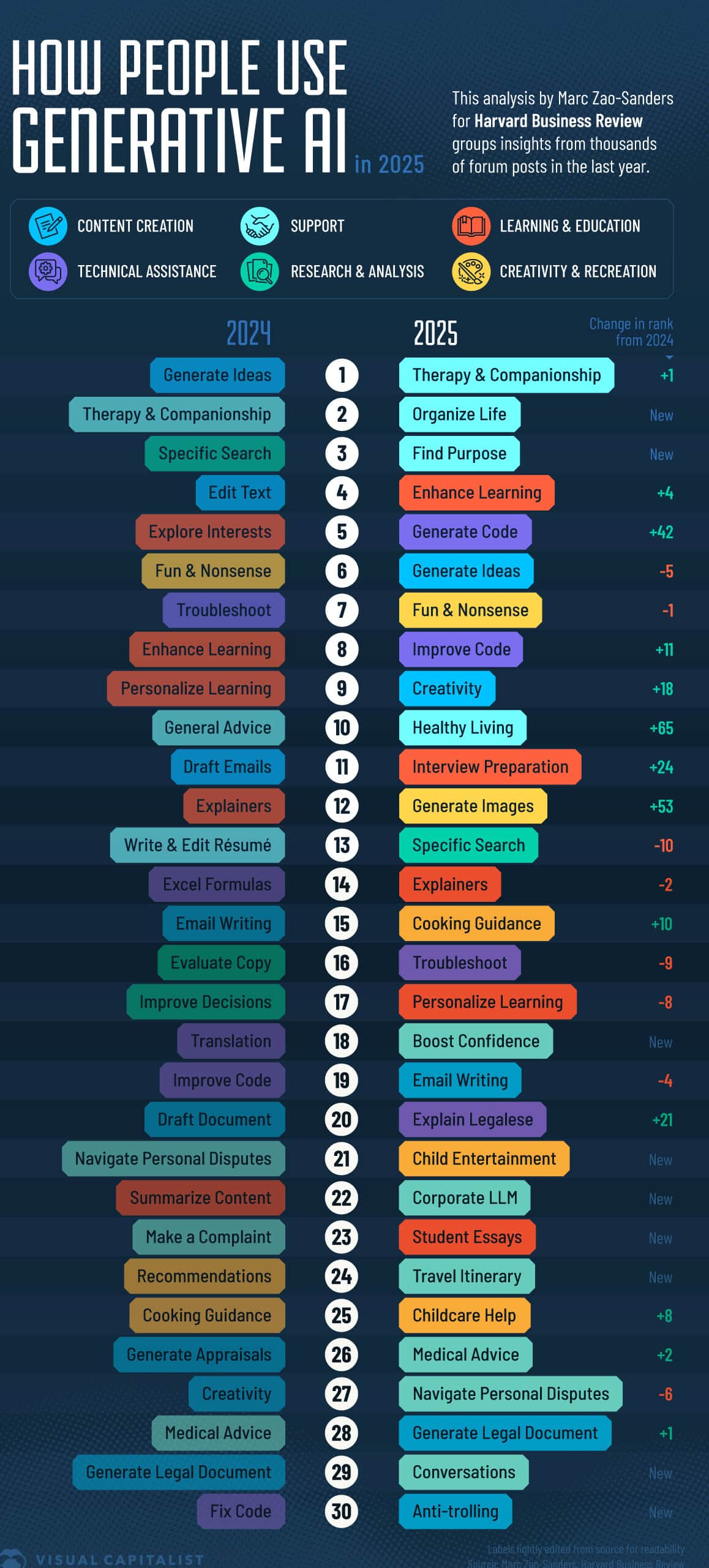
- Between 2024 and 2025 actual AI use evolved significantly, with therapy and companionship emerging as the top category.
-
- ChatGPT now serves 800 million weekly active users and processes roughly 2.5 billion prompts every day.
-
- While ChatGPT ads for mental health practices are not currently an option, your organic AI search strategy matters.
For much of the past year, advertising on ChatGPT was available only to a small group of invited brands. Large agencies and enterprise advertisers gained access first, while most businesses watched from the sidelines and waited for the platform to mature.
That period has ended. OpenAI has opened self-serve advertising, and the opportunity remains significant, but the market is moving quickly.
Why this Matters for Mental Health Professionals: Top Use of Gen A.I. in 2025 is ‘Companionship & Therapy’
Marc Zao-Sanders’ research in the Harvard Business Review makes one point clear: generative AI is no longer just another tech tool. In 2025, “Companionship & Therapy” became the top reported use category, which means people are already bringing emotional questions, relationship stress, anxiety, and self-reflection into AI conversations.
For mental health professionals, that matters. Showing up in ChatGPT is not about replacing care with AI. It is about being visible at the moment someone is looking for language, clarity, and a trusted next step toward real human support.
Why Mental Health & Behavioral Health Groups Should Care about ChatGPT Ads
The current policy is restrictive. According to OpenAI’s Ads FAQ:
“Advertisers in sensitive or regulated verticals such as dating, health, financial services, or politics are excluded from advertising on ChatGPT at this time.”
OpenAI also states that ads are not eligible to appear near conversations involving:
-
- Personal health
-
- Mental health
-
- Politics
-
- Other sensitive or regulated topics
Today, mental health practices can’t meaningfully advertise in ChatGPT, but they can absolutely compete for visibility in ChatGPT’s answers and prepare for the future for when they can advertise in ChatGPT.
ChatGPT Ads for Mental Health Practices Signals Worth Paying Attention To
Signal #1: OpenAI is already relaxing some restrictions
When ChatGPT ads first launched, entire categories of conversations involving medical, legal, and financial advice were broadly excluded. In April 2026, OpenAI updated its placement policy and moved to a more nuanced approach. Medical, legal, and financial advice contexts are no longer categorically blocked, although sensitive conversations remain ineligible for ads.
That suggests OpenAI is willing to evolve its policies as it gains confidence in its safeguards.
Signal #2: Mental health remains specifically excluded
OpenAI has repeatedly stated that ads cannot appear near conversations involving health, mental health, or politics. It also excludes advertisers in sensitive verticals such as health from the ad platform “at this time.”
The phrase “at this time” is notable. Companies rarely use that language if they intend a permanent prohibition.
Signal #3: OpenAI has a massive incentive to eventually solve healthcare advertising
OpenAI is building what could become one of the largest advertising businesses on the internet. Analysts project tens of billions in future ad revenue if adoption continues.
Healthcare is one of the largest digital advertising categories in the world. It would be surprising if OpenAI permanently left that revenue on the table.
The more likely outcome is a phased approach:
-
- No healthcare advertisers.
-
- Highly regulated healthcare categories with strict review.
- Broader healthcare access with extensive safeguards.
Signal #4: OpenAI is simultaneously investing heavily in healthcare
This is the most interesting signal for mental health marketing.
OpenAI has been expanding healthcare-related products and reports tens of millions of health-related queries. The company has publicly discussed healthcare initiatives and clinician involvement in health-focused AI experiences.
If OpenAI continues moving deeper into healthcare experiences, it becomes harder to imagine a future where healthcare organizations are permanently excluded from participating in the ecosystem.
Why This Channel Works Differently
Many advertisers will be tempted to reuse search ads, social creative, and existing landing pages. In most cases, that approach will produce disappointing results because the environment inside ChatGPT operates differently from traditional digital channels.
Users arrive in ChatGPT to have conversations. They ask questions, refine those questions, explore alternatives, and receive synthesized answers that help them make decisions. By the time a product or business appears, the user has often spent several exchanges narrowing the problem and evaluating possible solutions.
For a mental health service, this means someone may begin with, “Why do I feel anxious all the time?” and end up asking, “Should I look for a therapist, psychiatrist, or intensive outpatient program near me?”
By the time they encounter a mental health provider, they are not at the very beginning of their research.
ChatGPT has already helped them understand possible next steps, compare care options, and narrow what kind of support they may need. The person is closer to choosing a provider, requesting an appointment, or finding the most convenient location.
That makes the environment different from traditional search.
The practice is not interrupting a casual scroll or waiting for a broad keyword search. It is appearing inside a focused, high-intent conversation when someone may be ready for a clear, compassionate path forward.
What You Can Do in the Meantime
While mental health providers are not currently eligible to advertise in ChatGPT, it is essential to show up in front the growing number of people using AI to research mental health topics. Every day, users ask ChatGPT questions about anxiety, depression, trauma, ADHD, relationships, and finding the right therapist.
The opportunity today is not to buy visibility, but to earn it.
Organizations can start by creating helpful, expert-driven content that answers the questions people are already asking. Articles that explain treatment approaches, compare therapy options, address common concerns, and provide practical guidance are more likely to align with how people use AI tools.
Content that demonstrates real clinical expertise and covers a specialty in depth can help establish authority over time.
Mental health groups should also continue investing in the fundamentals that support both traditional search and AI visibility: strong local SEO, an optimized Google Business Profile, positive reviews, clinician bios, directory listings, and mentions across trusted websites.
As AI-powered discovery continues to evolve, the organizations that consistently publish useful information and build a strong online presence will be best positioned to be recommended when potential clients begin their search for help.
Conclusion
Generating more than $100 million in annualized revenue within six weeks while serving ads to fewer than 20 percent of eligible users suggests that ChatGPT advertising is gaining traction faster than many observers expected. Advertising dollars tend to follow attention, and attention is steadily shifting toward conversational interfaces.
Mental health practices cannot buy their way into ChatGPT conversations yet, but the organizations that build visibility now will have a real advantage when that changes. The fundamentals that earn you a presence in AI-generated answers, authoritative content, strong local SEO, trusted directory listings, and a consistent online presence, are the same ones that will position your practice to compete when behavioral health advertising opens up. The window to get ahead of that shift is open right now, and it will not stay open indefinitely. If you are ready to build the kind of visibility that works across both traditional search and AI discovery, we would love to help you get there.
Wise Wolf helps mental health groups build visibility in both traditional and AI search. If you want to know where you stand and what to do next, start with a free consultation.