You’re reading something about marketing, and suddenly there are four terms staring back at you: SEO, GEO, AEO, “AI SEO.” Some articles treat them as completely separate disciplines. Others wave them off as the same thing with different names.
Nobody seems to agree, and honestly, the marketing world has a habit of coining new terms faster than most people can keep up.
This post isn’t going to make it more complicated. Each term gets a plain definition, an honest look at where they overlap, and some practical direction on what’s worth your attention if you’re running a small or mid-sized practice.
Start With the One You Know: SEO
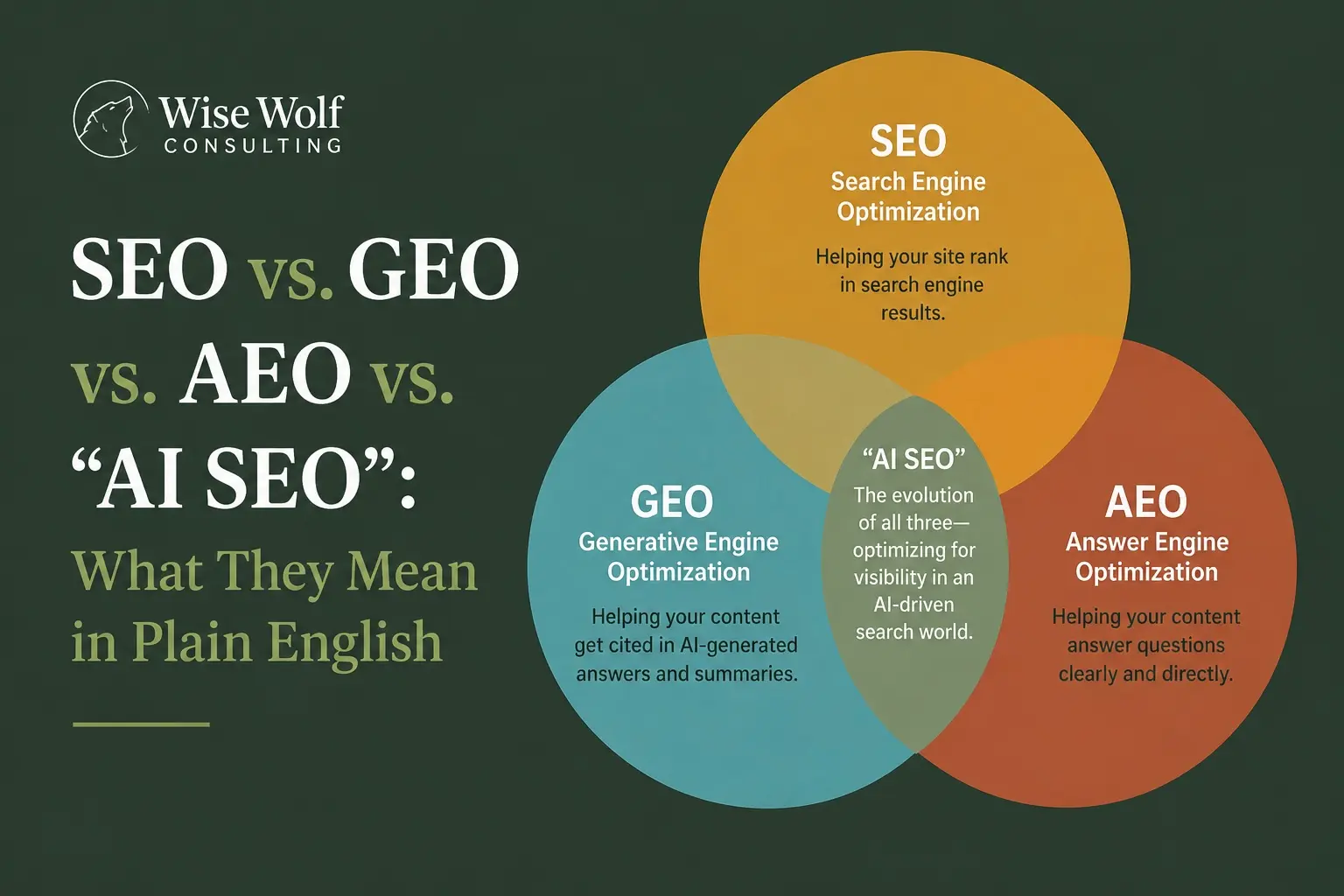
Search Engine Optimization has been around for decades. At its core, it’s the work you do so your website shows up when people search on Google, Bing, or similar platforms.
Three things drive it: useful content, a technically healthy website, and other credible sites linking back to yours. When someone searches for “(your service) near me” or “how to manage anxiety,” SEO is what determines whether your site appears on page one or somewhere nobody looks. It’s still the foundation. The term ‘SEO’ still drives enormous search volume every month. It’s not fading.
Everything else in this post builds on top of SEO, or overlaps heavily with it.
AEO: Optimizing for Direct Answers
AEO stands for Answer Engine Optimization. The goal is specific: get your content pulled as a direct answer inside search results, before anyone clicks through to your site.
You’ve seen this in action. The boxed answer that appears at the top of Google results when you ask a question. The “People Also Ask” section. Knowledge panels. Those are the placements AEO targets.
To show up there, your content needs to answer questions clearly and directly, with a structure that search engines can extract cleanly. According to HubSpot’s 2026 breakdown of AEO vs. GEO, AEO works best for high-intent, question-driven queries where users want a fast, specific answer.
For a therapy practice, this matters when someone searches “what is EMDR therapy” or “how long does therapy usually take.” A well-structured, direct answer on your services page can land in that top position without requiring a click. That kind of visibility still puts your name in front of someone actively researching.
The term AEO is relatively new. The concept, writing content that answers questions cleanly, has been part of solid SEO practice for years.
GEO: Getting Cited by AI Systems
GEO stands for Generative Engine Optimization. This one is genuinely newer territory.
The goal is to have your brand or content referenced inside AI-generated responses on platforms like Google AI Overviews, ChatGPT, and Perplexity. When someone asks ChatGPT “What should I look for in a (your service)?” GEO is what influences whether your site gets mentioned in that response.
A few things work differently here compared to traditional SEO. Ahrefs’ analysis of GEO points out that unlinked brand mentions carry more weight for AI systems than they do for search engines. Traditional SEO cares about hyperlinks. AI systems learn from text across the web, so being written about on credible sites, even without a clickable link, helps build your presence in how those systems understand your brand.
There’s another difference worth knowing. Research from Ahrefs found that AI systems show a clear preference for citing core website pages: homepages, about pages, and services pages. They cite these far more often than blog posts or listing pages. For most practices, that means your core pages deserve more attention and specificity than they typically get.
GEO tactics are still developing. Anyone claiming a guaranteed formula is guessing.
“AI SEO”: The Umbrella Term
“AI SEO” and its cousins, LLMO (Large Language Model Optimization) and AIO (AI Optimization), all point toward the same underlying shift: visibility now means more than ranking in Google. It also means appearing in AI-generated responses that people use when they’re researching and making decisions.
Backlinko explains, the reason there are so many overlapping terms is straightforward. People from SEO, content writing, PR, and data backgrounds all started approaching the same problem from different angles, and each group named it differently. The terms multiplied because the shift itself is real, but nobody coordinated the vocabulary.
Practically, the shift matters. According to HubSpot’s 2024 Consumer Trends Report, 72% of consumers surveyed said they plan to rely more on AI-powered search when shopping. That’s a real behavioral change, not just industry chatter.
How Much Do They Actually Overlap?
Honestly, quite a bit more than most comparisons suggest.
Quality content helps across all of them. Clear structure helps across all of them. Website credibility and external mentions do too. As Ahrefs notes, the core mechanism for improving visibility in AI output is creating relevant, well-structured content on topics your brand wants to be associated with, both on and off your site. That’s more or less the definition of SEO.
Search engines and AI systems are both trying to surface trustworthy, relevant information for users. The platforms work differently, but the underlying sorting problem is similar enough that the same inputs tend to help both.
Where things actually diverge is narrower than the terminology implies. Traditional SEO weighs hyperlinks heavily as a trust signal. AI systems lean more on how often your brand gets mentioned across the web, with or without a link attached. Some AI tools also have trouble reading JavaScript-rendered content in ways that Google has largely worked around already.
For most small practices, the day-to-day work looks nearly identical across all of these: write clearly, answer real questions, keep your site technically healthy, and build credibility through mentions and useful content.
What to Actually Focus On
Solid SEO is still the foundation. If search engines can’t find your site, AI systems will likely hit the same wall. Get the technical basics right first.
Content that leads with the answer performs well across formats. Frame a section with a question, answer it directly in the first sentence or two. That structure helps with featured snippets, AI Overviews, and rankings together.
Homepages, about pages, and services pages get cited by AI systems more frequently than blog posts do. If those pages are vague or haven’t been updated in a while, spending time there first makes more sense than publishing new content on top of a weak foundation.
Mentions beyond your own site help too. Guest posts, directory listings, contributions to credible publications. An unlinked mention in a trusted publication can carry more weight for AI visibility than several blog posts nobody links to.
Technical basics still apply: HTTPS, reasonable load speed, no major broken links.
Less Jargon, More Clarity
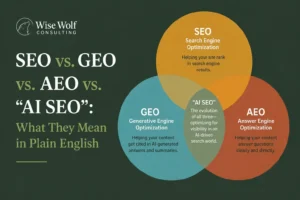
SEO, GEO, AEO, and AI SEO largely describe the same underlying work with different labels attached. Treating them as separate strategies with separate budgets tends to overcomplicate something that’s fairly straightforward in practice.
More people are getting answers directly from AI tools before visiting a website. That’s a real shift in how visibility works. What hasn’t changed is what makes content worth surfacing in the first place: credibility, clarity, and usefulness.
Good content and a technically sound site still carry the most weight. More platforms are reading that content now, but the work itself looks pretty familiar.
At Wise Wolf Consulting, we help businesses improve their visibility in AI-powered search by building the authority, structure, and content that AI systems rely on when generating answers. AI Search isn’t replacing SEO, it’s changing how people discover businesses.
Not sure how your practice shows up across Google and AI search? Contact us to start the conversation.