Key Takeaways
- AI Overviews aren’t a separate system to figure out. Google’s AI features pull from the same search index and quality standards regular Google Search has always used, so strong SEO fundamentals still come first.
- Skip the AI-only tricks. Special files like llms.txt, breaking content into tiny chunks, and rewriting text specifically “for AI” are all things Google has directly said don’t help, no matter what some services claim.
- Original content beats generic content. A page built on real research, firsthand experience, or specific data stands out far more than a generic overview anyone could have written.
- Being findable and being worth quoting are two different things. A site can be fully accessible to Google and still have nothing worth citing. Closing that gap means adding real substance, not just fixing technical settings.
- Answer the question first, then explain. A heading should be followed immediately by a direct answer, with the deeper explanation coming after, not the other way around.
- Track real results, not guesses. Search Console’s Generative AI performance report shows actual data from Google. No outside tool can see how Google’s AI systems really work behind the scenes.
Most sites treat AI Overviews like a mysterious new algorithm waiting to be reverse-engineered. Google itself says something a lot less dramatic. Its generative AI features are built on the same core ranking and quality systems that have mattered for years, not a parallel discipline requiring an entirely different playbook.
Google’s own developer guidance explains the mechanism plainly. Generative AI features rely on retrieval-augmented generation, meaning the system pulls from Google’s existing Search index to build its answers. A page still has to earn a spot in that index the normal way first, through the same technical and quality bar that’s applied for over a decade.
This piece exists to separate what actually matters here from the flood of GEO hacks currently circulating, most of which Google has already addressed directly.
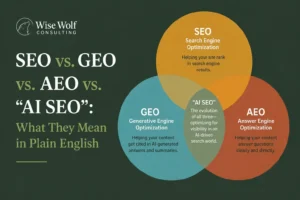
Need a reminder of SEO / GEO / AEO? Read our blog: “SEO vs GEO vs AEO vs AI SEO: What They Mean in Plain English”
You don’t need to create an entirely new website to appear in AI Overviews. Instead, make the SEO fundamentals stronger while creating content that’s useful, clear, original, and easy for Google’s systems to understand.
If the goal is to optimize content for Google AI Overviews, the starting point is the same set of principles that already make content valuable in traditional search.
What’s New: Retrieval, Not Ranking
Google has a searchable library of the web called the Search index. It’s basically the massive collection of pages Google has already crawled and organized, and it’s what regular Google Search has always pulled results from.
When Google’s AI writes a summary at the top of the search results, it uses a method called retrieval-augmented generation, also called grounding. Here’s what that actually means in plain terms: instead of the AI just making something up from memory, it goes and finds a handful of real, up-to-date pages from that same Search index, reads what those pages actually say, and then writes its summary based on that information. That’s why AI Overviews show clickable links underneath the summary; they’re pointing back to the real pages it pulled the answer from.
There’s a second method Google uses called query fan-out, and it’s worth understanding because it changes how content gets found.
When someone asks a question, Google’s AI doesn’t just search for that one exact phrase. It quietly breaks the question into several related questions and searches for all of them at once, then combines what it finds into one answer.
Let’s understand this with an example.
Suppose someone searches “how to fix a lawn full of weeds.” Behind the scenes, Google’s AI might also search “best herbicides for lawns,” “removing weeds without chemicals,” and “how to prevent weeds from coming back.” A single page that only covers herbicides could still get pulled into the final answer, even though it never mentions “how to fix a weedy lawn” anywhere on the page.
The same thing happens with therapy-related searches. Someone might ask “how do I know if I need therapy?” Google’s AI could quietly also search “signs of anxiety,” “difference between therapy and counseling,” and “how much does therapy cost.” A practice’s page about anxiety symptoms could get pulled into that answer, even though the page never mentions the original question directly.
None of this changes the basic requirement underneath it, though.
Before any of this can happen, a page still has to already be indexed, meaning Google has actually crawled and added it to the Search index in the first place, and it has to be technically accessible, meaning nothing on the site is blocking Google from reading it.
Think of it as a starting line. A page has to cross that line just to be eligible for any of this, whether or not it ever gets pulled into an AI answer.
So instead of asking “how do I write content specifically for AI,” a more useful question is this: would Google actually be able to find this page, understand what it’s about, and trust it enough to use it in an answer? Everything else covered in this piece is really just different ways of answering that one question.
What Google Explicitly Says You Don’t Need
This point needs to be made clearly, especially given the number of AI-specific optimization tactics being promoted today. Google’s own mythbusting guidance lists specific tactics it says don’t help visibility in its generative AI features, including:
No special AI files or markup
Google says llms.txt and other special AI files aren’t required for Google Search. An llms.txt file is a separate text file some sites create specifically to try to talk to AI tools, similar in idea to the robots.txt file that’s been used for regular search engines for years.
Google says plainly it doesn’t use these files at all, so creating one won’t help a page get found in Google’s AI features. Also, no special schema markup is required specifically for appearing in generative AI features. Structured data can still serve its normal SEO purposes, but it isn’t an AI-search shortcut.
No formula for AI-friendly formatting
Google doesn’t require publishers to split every article into artificially short sections or follow a particular content length for generative AI visibility. It’s more important to write helpful information for your audience, even if it means having a short or longer article.
No need to force exact-match queries
Google’s systems can understand related language and meaning, so there is no reason to turn a useful article into a collection of awkward keyword variations simply to match every possible search phrase.
Create Content That Isn’t Commodity Content
Google draws a specific, useful distinction here. Commodity content is common knowledge that has no originality, something like a generic “What to Expect From Your First Therapy Session” post that provides no unique information. Non-commodity content brings a genuine first-hand perspective or lived experience to a topic, such as “What I’ve Learned From Helping Clients Who Struggle to Stay in Therapy,” a piece grounded in something a clinician has actually observed in practice, rather than a generic overview anyone could have written without ever practicing.
A firsthand experience or case study beats a vague claim. Semrush’s own research on AI search reinforces this from a different angle, finding that content carrying specific, sourced statistics gets cited by AI systems noticeably more often than content built on vague generalizations.
Google and Semrush arrive at this conclusion independently, one through official platform guidance and the other through industry research. This makes the finding especially reliable.
The Citation Readiness Gap
Across the sites we’ve reviewed, a familiar pattern shows up again and again. Most treat AI visibility as a list of technical boxes to check off, things like adding schema markup, splitting a page’s text into short chunks, or sprinkling in a few keyword variations, and then consider the job done. Google’s own guidance says plainly that this kind of checklist barely matters next to genuine content quality, and yet the checklist is usually where all the effort goes.
Call this the citation readiness gap, the distance between what a site’s content technically allows AI systems to crawl and what it actually gives them worth citing. A site can be fully crawlable, technically flawless, indexed cleanly, and still have nothing an AI system would ever choose to quote.
Being accessible and being worth quoting turn out to be two completely different problems, and most sites solve only the first one.
Most firms close the accessibility half of that gap and stop there, quietly assuming the technical fix was the whole job. It rarely is. The content that’s easiest for AI to summarize is also the easiest for everyone to create, meaning that when ten other pages say exactly the same thing, this content is least likely to be selected as citable.
The Difference Is What You Can Add That Others Can’t
The real opportunity sits in publishing something an AI system genuinely cannot reconstruct by blending ten competing articles that already say the same generic thing in slightly different words.
One pattern we’ve noticed is checking our own client pages against AI Overview citations: two nearly identical service pages, same topic, same word count, same technical setup, split on one difference. The page that opened with a specific claim tied to actual client work got pulled into an AI Overview.
The page that opened with the same broad industry framing everyone else uses didn’t, even though nothing else about it was weaker. The gap wasn’t accessibility. It was whether the first two sentences said anything the other nine competing pages hadn’t already said first.
Structure That Actually Helps Extraction
A good heading should tell the reader what they’re about to get. If a section is answering a question such as “How do I know if therapy might help with anxiety?” the answer shouldn’t be buried beneath a wall of general information. Give the person a clear starting point, then use the rest of the section to explain the details and where the answer may vary.
That’s useful for the reader first and makes the page easier for search systems to interpret because each section has a clear purpose.
Formatting a heading as a question, the way the anxiety example above does, is one simple way to get there. It isn’t the only way. The actual goal is making it obvious what a section is about to tell someone, right at the top of it. A heading that already does that clearly, question-shaped or not, doesn’t need to be rewritten just to force it into a question format.
There is a technical side to this too. Important content still needs to be crawlable, canonical tags need to work correctly, and nothing should prevent search engines from accessing the actual page content. For local practices, keeping business information current through Google Business Profile supports the same broader goal: giving search systems accurate information to work with.
Worth remembering here: structure should make content easier for a human reader first. AI readability should come out the other end of good organization done for people, not exist as a reason to format something artificially in the first place.
Monitor What AI Search Actually Shows
AI search creates a measurement problem because a traditional ranking position doesn’t tell the whole story anymore. A business can be mentioned in an AI Overview without being the first organic result.
A page can provide a source for an answer without receiving the same click it would have received from a traditional blue link.
So visibility needs to be looked at more broadly.
Google now provides a Generative AI performance report in Search Console to help site owners understand how their content performs in generative AI features on Google Search.
You can also manually test important questions and see:
- whether your brand appears
- which pages Google cites
- which competitors appear
- what types of information are being surfaced
- whether your content addresses the questions being asked
Semrush’s current research shows why this monitoring matters. Its July 2026 study of more than 600,000 keywords found that the appearance of AI Overviews for commercial-intent searches grew 71% over six months, showing that AI Overviews are not confined to purely informational queries.
Optimize for the Search Experience, Not the Algorithm
The goal isn’t to manufacture content that an AI can quote. It’s to become the source worth citing.
That means keeping the technical foundation clean, making expertise visible, answering real questions well, and giving people information they can’t get from ten nearly identical pages.
That’s the citation readiness gap we’ve been talking about: being findable is the baseline. Giving search systems a reason to use your information is the harder part.
Don’t Optimize for AI. Optimize for the Person Asking for Help.
When someone asks ChatGPT or Google a deeply personal question about anxiety, trauma, or relationships, your practice should be easy to understand and easy to find. Wise Wolf helps therapy practices turn their real expertise into a digital presence that can do both. Learn more about our AI Optimization Services or contact us today for a free consultation.